
Nigerian Dwarf Colors: A Guide to Coat Patterns and Colors
If there is one thing that can send a goat breeder down a rabbit hole faster than almost anything else, it is color.
One evening you're simply trying to identify the color of a kid that was born that morning. Before long, you've opened twelve browser tabs, pulled out old breeding records, compared photographs from five different farms, and found yourself muttering things like, "No... I think she's actually a chocolate cou clair with moonspots." I'll admit, I didn't start this way, but after realizing I got the color on a kid wrong, my "investigations" went FAR.
Welcome to the club.
One of the great joys (at least to me) of Nigerian Dwarf goats is that no two are quite alike. Even full siblings can look as though they belong to different breeds altogether. Some arrive dressed in black. Others seem to have borrowed a paintbrush on the way into the world. Some look nearly identical as kids only to change dramatically with age, while others keep the same striking appearance for years.
For many of us, color is what first catches the eye. It certainly isn't what keeps us breeding goats. Good udders, strong feet and legs, productive milkers, and sound conformation matter infinitely more than coat color. But color is fascinating. It adds another layer of wonder to an already remarkable breed.
For years, one website became the place many of us visited when trying to sort through Nigerian Dwarf goat colors and genetics. Recently, that site has become unavailable. Whether it returns someday or quietly slips into internet history, it reminded us how valuable it is when breeders take the time to share what they've learned.
That is the purpose of this page.
Not to be the final authority. Not to pretend every question has been answered. Simply to gather together the information that has helped us, present it in a way that is easy to understand, and continue adding to it as we learn.
If you're trying to identify a buckskin Nigerian Dwarf goat, wondering whether your kid is chamoisee or cou clair, curious about the chocolate modifier, or finally hoping to understand why everyone gets excited about moonspots, I hope you'll find something helpful here.
And if you're an experienced breeder, we'd love your help. If you have exceptional photographs that illustrate one of these colors or patterns, or you've learned something through years of breeding that deserves to be included, please reach out. The best resources are rarely written by one person. They're refined by a community willing to share what it has discovered and I am absolutely okay with being corrected!
Gold
Gold is one of the most recognizable and variable colors found in Nigerian Dwarf goats. It can range from a pale cream that almost appears white to a deep, rich red gold, with many beautiful shades falling somewhere in between.
From a genetics standpoint, gold is part of the Agouti series of alleles. Within that series, gold is strongly expressed when present, meaning a goat carrying a gold allele will typically display a gold phenotype rather than a different Agouti pattern that is lower in the dominance hierarchy.
A goat expressing gold must inherit a gold allele from at least one parent.
Gold itself is wonderfully variable. Some goats are a soft cream color. Others are a classic light or medium gold. Some deepen into dark gold or red gold shades. Environmental factors, age, and other genetic modifiers can also influence how that color appears over time.
For registration, gold goats are typically described by their shade, from all shades between cream and dark gold to even red gold (not to be confused with recessive red).


coat patterns
Patterns determine where color appears.
They are often the first thing experienced breeders notice because they create the recognizable appearance we associate with names like buckskin or Swiss Marked.
*The goat pictured above was one of the first kids I ever registered and I registered as Chamoise (it might have been Chamoisee), thinking his collar was an exception. Years later, I'm thinking either a buckskin/chamoise combo (most likely) or Bezoar. We sold his dam who was registered as buckskin with extensive white overlay (I never really thought she was buckskin), so it might be hard to figure out. Either way, try to register whatever is the most dominant coat pattern, in this case, I think either buckskin or chamoise would have been okay.
Buckskin
Buckskin is probably the pattern most people learn first because it is both common and beautiful.
Traditionally, buckskins have a darker body with lighter trim around the face, ears, legs, and underside, though expression varies considerably from goat to goat.
Buckskin is generally considered a dominant pattern, meaning only one copy of the gene is needed for the pattern to appear. If it interacts with (gold or silver), the phenotype of the goat will be gold (or silver), but she/he will carry buckskin in his/her genotype.


Chamoise (Buck) / Chamoisee (Doe)
Chamoisee (pronounced sham-wah, if you ask me) is one of the classic Nigerian Dwarf goat patterns and is a beautiful example of how much variety can exist within a single color family.
The pattern is most easily recognized by the darker markings that almost seem to frame the goat’s body. A traditional chamoisee will typically have a stripe running down the spine, darker facial stripes that run over the eyes, darker coloring along the belly, and darker legs from at least about the knees/hocks down. The darker areas may be black or chocolate depending on the goat’s genetics.
Some chamoisee goats also develop a darker collar or shoulder marking extending from the chest toward the shoulders, although this feature is not present on every goat. Like many Nigerian Dwarf patterns, the exact expression can vary from goat to goat, with shades ranging from light to dark. Chamoisee may also occur in chocolate, creating a softer brown version of the traditional pattern.
Chamoisee is also dominant, though overwritten, as was buckskin, by Gold and Silver.
For registration, chamoisee goats are generally described by their shade, such as only chamoisee, dark chamoisee, red chamoisee, or chocolate chamoisee.
Cou Clair / Cou Blanc
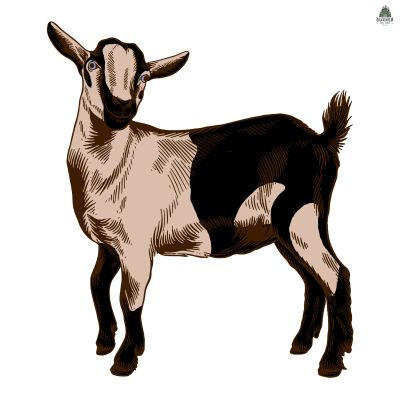
Cou Clair is basically an inverse of buckskin. Where you generally see darker areas on a buckskin goat, you'd see lighter on Cou Clair and vice versa. The name literally means "light neck," and once you know the name, it's much easier to remember the pattern. The front portion of the goat is noticeably lighter than the hindquarters.
Cou clair is dominant and can be modified by other patterns and replaced by gold and silver. Cou blanc is the lightest form of this pattern on the neck (nearly white).
Sundgau
Sundgau is one of the classic Nigerian Dwarf goat patterns often confused with Swiss Marked. At first glance, they can look surprisingly similar.
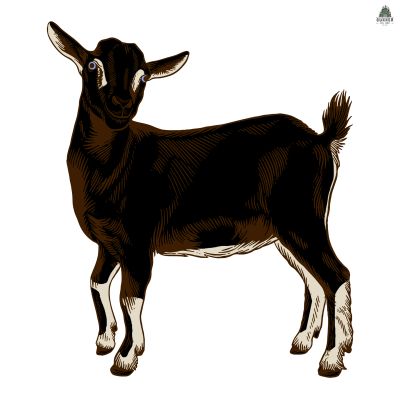
A traditional Sundgau goat has a black or chocolate / dark tan body with lighter markings on the legs, underbelly, and face. The lighter areas are usually tan, cream, or gold in color and create a beautiful contrast against the darker body. Sundgau goats often have darker stripes running down the front of the legs (inside the lighter colored markings), and the face may show lighter facial markings or stripes above the eyes and partway down the face.
In order to distinguish Sundgau from Swiss Marked look at the underbelly and rear. In a true Sundgau, the belly is lighter and there is no distinct triangular rear marking.
To make things even more interesting, Sundgau and Swiss Marked can occur together. Not every goat fits perfectly into a single category, and additional patterns or modifiers can create appearances that do not look exactly like a textbook example.
Sundgau is also sometimes mistaken for a heavily extended buckskin. In some buckskin goats, the darker "cape" can spread farther down the body as they age, creating a goat that appears to have an entirely dark body with lighter markings similar to Sundgau. To clarify, have a look at older pictures (kid pictures would be best), pictures of parents or kids, and perhaps shave to see what's underneath.
Like many Agouti patterns, Sundgau is considered dominant within the Agouti series. However, dominance does not mean the final appearance is always predictable. Other alleles and modifiers can influence how the pattern is expressed, creating the incredible variety seen throughout the Nigerian Dwarf breed.
For registration, this pattern is generally recorded as Sundgau.
Swiss Marked
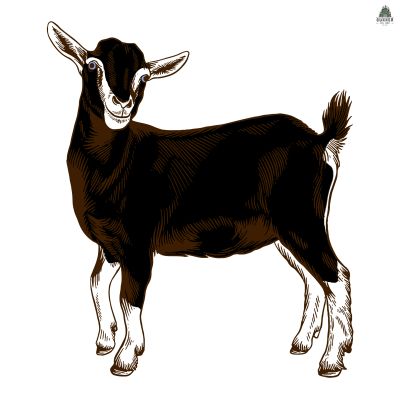
Swiss Marked is one of the most recognizable and eye-catching patterns found in Nigerian Dwarf goats. It is a beautiful contrast of a darker body color paired with lighter markings that create the distinctive "Swiss" appearance.
Swiss Marked goats display tan or cream points above the eyes, along the muzzle, inside the ears, down the legs, and beneath the tail. One of the defining characteristics of the pattern is the lighter triangular markings found on the rear end, which are often one of the easiest ways to distinguish Swiss Marked from similar patterns.
If you've ever heard someone describe a goat as having "eyebrows," this is probably what they meant.
Swiss Marked is a dominant pattern. However, like all coat genetics, dominance does not mean every offspring will look identical. The combination of alleles inherited from both parents determines what pattern is ultimately expressed and how it may combine with others.
For registration purposes, Swiss Marked is generally recorded as Swiss Marked or chocolate Swiss Marked depending on the darker area of pigment.
Bezoar
Bezoar is one of the oldest and most distinctive patterns found in goats, named after the wild bezoar goat, one of the ancestors of domestic goats. It carries a beautiful connection to the history of the species and gives a glimpse into what some of the earliest goat patterns may have looked like.
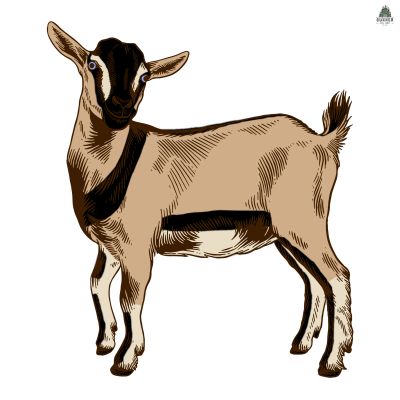
The pattern is characterized by a dark dorsal stripe running down the spine, facial stripes (one dark, one light), lighter coloring along the underside of the body, separated from the main body color by a dark stripe, and lighter markings from the knees/hocks down with darker markings along the front of the legs extending beyond the lighter areas. These markings create a more natural, "wild type" appearance compared to some of the other patterns seen in Nigerian Dwarf goats.
Bezoar can vary in shade, with some goats appearing lighter and sandy in color while others have deeper, richer tones. The darker markings may be black or chocolate depending on the goat’s genetics. Like many Agouti patterns, the final appearance can be influenced by other alleles and modifiers, creating subtle differences between individuals.
Because of its markings, Bezoar is sometimes confused with Chamoisee. Both patterns can have a golden or tan base with darker markings but the placement and expression of those markings help distinguish them.
Bezoar is considered dominant. A goat expressing Bezoar must inherit that allele from at least one parent, although the exact appearance of the pattern will depend on the other genetics carried by the goat.
Modifiers
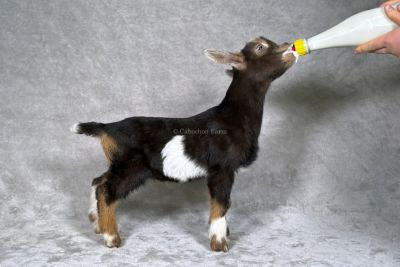
Chocolate
Image: Our chocolate Swiss Marked buck, Cabochon BO Jacque Cousteau. Photo Credit: Cabochon Farm
The chocolate modifier changes black pigment into varying shades of brown.
Genetically speaking, chocolate is not a completely separate pattern. Instead, it is a modifier that changes the way black pigment is expressed. A goat that would otherwise have black coloring has that pigment diluted into shades of brown instead.
Because chocolate modifies pigment rather than creating a new pattern, it can appear alongside many different coat patterns. The pattern remains the same, but the black areas are changed to chocolate. A buckskin goat with the chocolate modifier, for example, will still have the familiar buckskin pattern, but the darker cape will appear chocolate rather than black. A Swiss Marked goat may have chocolate points instead of black.
Chocolate is considered a dominant trait, meaning that a goat carrying the chocolate modifier will typically express chocolate anywhere black pigment would have appeared. However, as with all coat genetics, the final appearance depends on the combination of genetics the goat carries.
Chocolate can also interact with gold-based colors. In those cases, the goat may not appear obviously chocolate because the underlying pigment is different. Instead, the chocolate modifier can soften or warm the gold expression, creating shades sometimes described as chocolate gold.
For registration purposes, goats are generally recorded as chocolate with the name of the pattern that is being modified, such as chocolate buckskin or chocolate Swiss Marked. A gold goat influenced by chocolate may be recorded as chocolate gold.
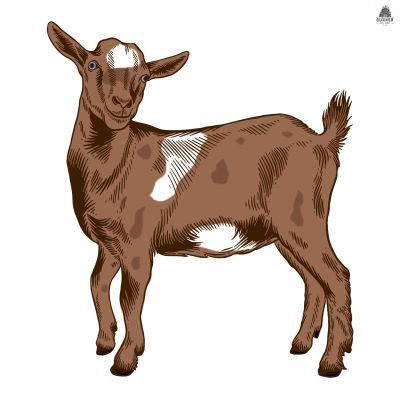
White Spotting
Image: Gold with white spotting and moonshots
White spotting is one of the many ways Nigerian Dwarf goats can develop unique and eye-catching coats. Unlike colors such as black, gold, or chocolate, white spotting does not determine the goat’s base color. Instead, it creates areas where pigment is reduced or absent, allowing white markings to appear over the goat’s underlying coat pattern, simply a modifier.
White spotting can vary dramatically from goat to goat. Some may have only a small white patch, perhaps on the forehead or side. Others may have large areas of white covering much of the body while still retaining their original color and pattern underneath.
This is why two goats with the same underlying genetics can look completely different. A black goat with a small amount of white spotting may appear mostly black, while another black goat with more extensive white spotting may look almost entirely white with only small areas of black remaining.
White spotting can occur alongside many different patterns and colors. A buckskin goat with white spotting is still genetically buckskin, will be registered as buckskin (with white to varying degrees, depending on amount of white present) but the white markings are layered over that pattern. Any pattern can have white spotting, creating combinations that are unique to that individual.
The genetics behind white spotting can be complex, and breeders often use terms such as "white spotting," "pied," or "pinto" when describing these markings. The amount and placement of white can vary widely, even among related goats.
For registration, white markings are typically recorded as additional markings rather than replacing the goat’s primary color or pattern. You'll generally see registration as "[pattern] with [level of white spotting] white. Levels of white spotting can be: minimal white, broken/random white, adbundant/extensive white overlay, or belted white. You might also see registrations such as broken [pattern] i.e. broken buckskin (white makes up no more than 25-30% of the goat).